281-647-7766

Visit Us410 West Grand Parkway South
Suite #4C, Katy, TX 77494
Suite #4C, Katy, TX 77494
Office HoursMon – Thu: 8:30 AM – 5:00 PM
Fri: 8:30 – 4:00 · Sat: 9:00 – 1:00
Fri: 8:30 – 4:00 · Sat: 9:00 – 1:00
281-647-7766
Home/Cancer Treatment/Melanoma
Melanoma is the most serious type of skin cancer, but immunotherapy and targeted therapy have transformed its outlook. Board-certified oncologists Dr. Mohammad Riaz and Dr. Shagufta Naqvi treat melanoma after surgery and when it has spread, working closely with your dermatologist and surgeon. Same-day appointments for newly diagnosed patients.
Overview
Melanoma is a cancer of the pigment-producing cells in the skin. It is less common than basal cell or squamous cell skin cancer but far more likely to spread to lymph nodes and organs if it is not caught early. Melanoma can also start in the eye, under the nails, on the palms and soles, and rarely in mucous membranes.
Main types include superficial spreading melanoma (the most common), nodular melanoma (grows quickly in depth), lentigo maligna melanoma (sun-damaged skin of older adults) and acral lentiginous melanoma (palms, soles and nail beds, and the most common type in people with darker skin). Learn more: what is melanoma and how is it diagnosed.
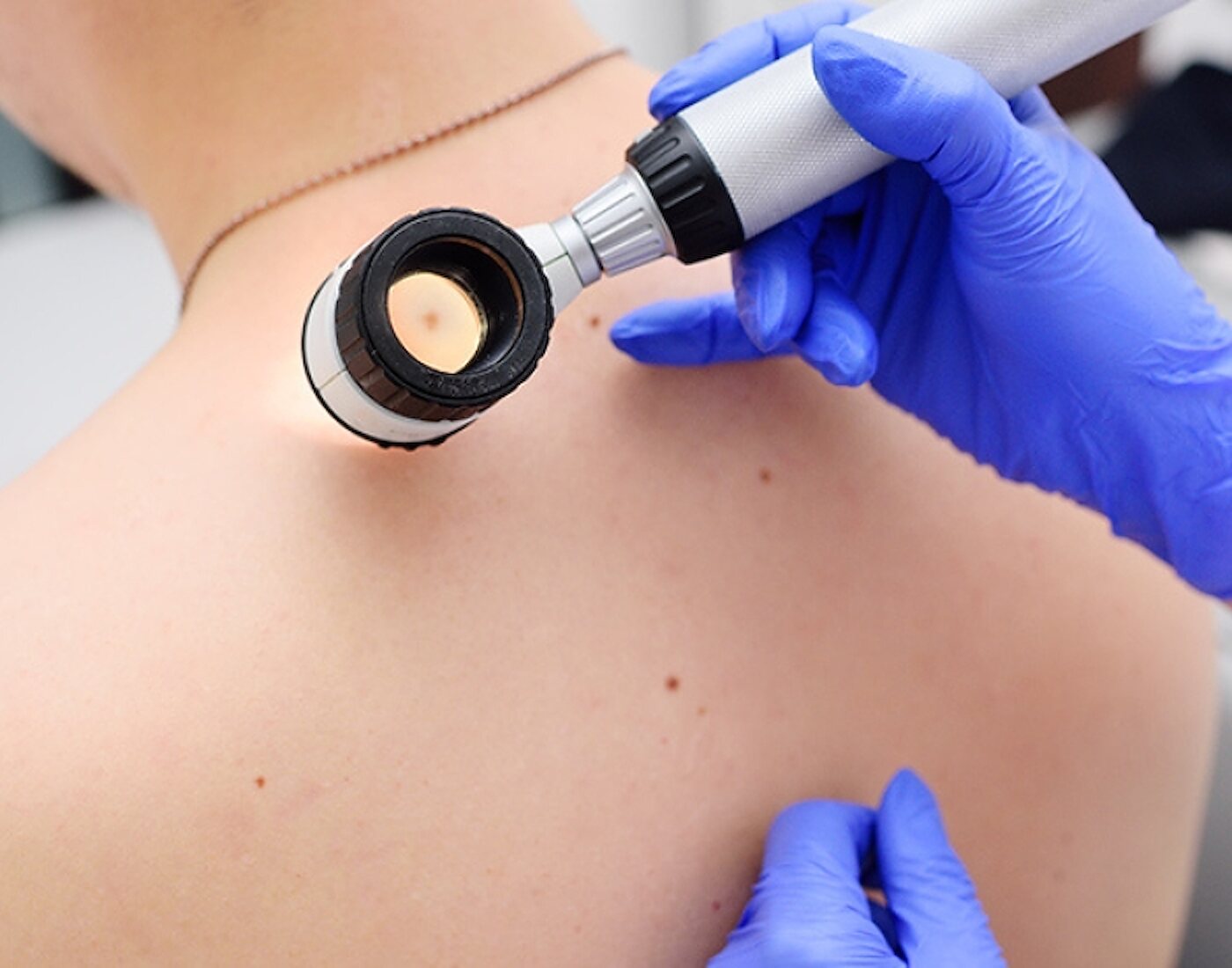
Melanoma usually appears as a new dark spot or a mole that changes in size, shape or color. Warning signs are summed up by the ABCDEs: asymmetry, irregular borders, more than one color, a diameter over 6 mm, and evolution over time. A spot that looks different from your other moles (the “ugly duckling” sign) should also be checked.
| Letter | What to look for |
|---|---|
| A – Asymmetry | One half does not match the other |
| B – Border | Ragged, notched or blurred edges |
| C – Color | Shades of brown, black, red, white or blue |
| D – Diameter | Larger than 6 mm (about a pencil eraser), though melanomas can be smaller |
| E – Evolving | Changing in size, shape, color, height, or starting to itch or bleed |
Also see does skin cancer itch, skin cancer symptoms and lumps under the skin.
Ultraviolet (UV) exposure from the sun and tanning beds is the main cause. Risk is higher for people with fair skin, freckles or light hair, many moles or unusual moles, a history of blistering sunburns, a personal or family history of melanoma, and a weakened immune system. Melanoma can occur in people of any skin color.
Lifetime risk is about 1 in 33 for White people, 1 in 200 for Hispanic people and 1 in 1,000 for Black people. Read about melanoma risk factors and prevention.
A skin biopsy confirms melanoma and measures its thickness (Breslow depth) and whether it is ulcerated. A sentinel lymph node biopsy is often done for melanomas thicker than 0.8 mm. For higher-stage melanoma, PET/CT or CT and brain MRI look for spread, and the tumor is tested for a BRAF mutation.
| Stage | What it means |
|---|---|
| Stage 0 | Melanoma in situ, top layer of skin only |
| Stage I–II | Confined to the skin; stage depends on thickness and ulceration |
| Stage III | Spread to nearby lymph nodes or nearby skin |
| Stage IV | Spread to distant skin, lymph nodes or organs such as the lungs, liver or brain |
About half of melanomas have a BRAF V600 mutation, which can be treated with targeted pills.
Early melanoma is cured with wide local excision by a dermatologist or surgeon. For stage IIB to III melanoma, a year of immunotherapy after surgery lowers the risk of recurrence, and some stage III patients benefit from immunotherapy before surgery. Advanced melanoma is treated with immunotherapy combinations or, for BRAF-mutated tumors, BRAF plus MEK inhibitor pills.
Wide local excision with a margin of normal skin, and sentinel lymph node biopsy when needed, performed by your surgeon or dermatologist.
Used for: All stages that can be removed
Pembrolizumab or nivolumab for about one year after surgery to lower the chance of recurrence.
Used for: Stage IIB, IIC, III and resected IV
Pembrolizumab started before surgery and continued after, which improves outcomes for many patients with stage III disease.
Used for: Operable stage III
Nivolumab with ipilimumab, nivolumab with relatlimab, or single-agent PD-1 therapy, given by IV in our office.
Used for: Advanced or metastatic melanoma
Oral BRAF and MEK inhibitors such as dabrafenib with trametinib or encorafenib with binimetinib.
Used for: BRAF V600-mutated melanoma
Tumor-infiltrating lymphocyte (TIL) therapy at specialized centers, and focused radiation for brain or bone metastases.
Used for: Selected advanced melanoma
Immunotherapy can cause the immune system to inflame healthy organs. Common effects are fatigue, rash, itching, diarrhea and thyroid changes. Less often it affects the lungs, liver, colon or hormone glands. Most side effects are mild and treatable when reported early, so call us about any new symptom.
We check blood work before each treatment and manage side effects quickly, often with steroids. Dr. Riaz’s Cleveland Clinic palliative care training means symptom control is part of every plan.
About 99% of people with melanoma that has not spread are alive five years later, about 75% when it has reached nearby lymph nodes, and about 35% when it has spread to distant organs, a number that keeps rising with modern immunotherapy. Protect yourself with sunscreen (SPF 30+), protective clothing, shade, no tanning beds and regular skin checks.
After melanoma, follow-up includes skin exams every 3 to 12 months, depending on stage, and imaging for higher-risk patients. Anyone who has had melanoma has a higher chance of a second one, so monthly self-checks and yearly dermatology visits are important. See melanoma diagnosis and key facts.
Call 281-647-7766 or request a call back. Newly diagnosed patients can usually be seen the same day. We accept most major insurance plans and Medicare, including AARP, Aetna, Blue Cross Blue Shield of Texas, UnitedHealthcare, Tricare and TMHP, and our staff handles prior authorizations before treatment begins.
Bring your referral, biopsy or pathology report, recent scans and lab results, a list of your medicines and your insurance card. If you do not have every record, call anyway. Our team can request them for you. You can also fill out our patient registration form ahead of time.
Board-Certified Medical Oncologist
Dr. Naqvi brings years of experience treating a wide range of cancers with a focus on personalized medicine, patient advocacy and compassionate care.
Board-Certified Medical Oncologist & Palliative Care Specialist
Dr. Riaz completed a Palliative Medicine Fellowship at the Cleveland Clinic, so patients receive cutting-edge cancer therapy while keeping the highest possible quality of life.
Our oncology office is located at 410 West Grand Parkway South, Suite #4C, Katy, TX 77494, with easy access from I-10 and the Grand Parkway. Patients come to us for melanoma care from Katy, Cinco Ranch, Fulshear, Richmond, Sugar Land, Memorial, the Energy Corridor, West Houston and communities throughout Greater Houston.
Hours: Monday–Thursday 8:30 AM–5:00 PM · Friday 8:30 AM–4:00 PM · Saturday 9:00 AM–1:00 PM
Phone: 281-647-7766 · Fax: 281-647-7767 · Map & directions
Yes. Most melanomas are found early and cured with surgery. Even advanced melanoma can sometimes be controlled for many years, and some patients are cured with immunotherapy.
Yes. Melanoma can develop on the soles of the feet, palms, under nails, in the mouth or genitals and in the eye. Acral melanoma on the palms, soles and nail beds is the most common type in people with darker skin.
For stage 0 to IIA melanoma, a dermatologist or surgeon usually provides all treatment. Stage IIB and higher, or any melanoma that has spread, should be evaluated by a medical oncologist to discuss immunotherapy or targeted therapy.
A procedure that finds and removes the first lymph node or nodes that drain the area of the melanoma, to check whether cancer has spread. It helps decide whether you need further treatment.
After surgery, usually about one year. For advanced melanoma, often up to two years, depending on response and side effects.
Premier Oncology Consultants treats melanoma at 410 West Grand Parkway South, Suite #4C, Katy, TX 77494, serving Katy, Fulshear, Richmond, Sugar Land, Memorial and West Houston.
Sources
This page is for education only and does not replace medical advice from your own physician. Treatment decisions should be made with your care team based on your individual diagnosis.
Same-Day Appointments in Katy
Same-day consultations for newly diagnosed patients, in-office immunotherapy and most insurance accepted, in Katy, serving all of Greater Houston.
Same-Day Appointments · Katy, TX
Share your details and our Katy team will call you back, usually the same business day.
Please do not include detailed medical information. Your details are used only to contact you about your appointment.